
Your business command center.

Groundwork is a ready-made desktop workspace that works with your AI. Bring company facts, plans, decisions, questions, documents, and AI advisors together in one organized system.

One-time purchase. Local files. No hosting or subscription software required.

See the whole business and keep it current.

Groundwork starts with a complete structure for understanding the company, reviewing decisions, finding gaps, and keeping your AI grounded in the same current information.

42 core website pages

See your company, goals, customers, offers, finances, work, risks, decisions, and open questions in one clear place.

A page for every business line

Give each confirmed product, service, subscription, program, brand, or location its own operating view.

Eleven business advisors

Review the same current business information from strategy, product, customer, finance, marketing, sales, operations, technology, AI, people, and risk perspectives.

Tools for review and updates

Review information, find gaps, track decisions, manage updates, and keep notes about meaningful changes.

Your local business website

See what your AI is working from.

Groundwork builds a website on your computer where you can review your company information. Update the information or customize the website by telling AI what to change in a simple chat.
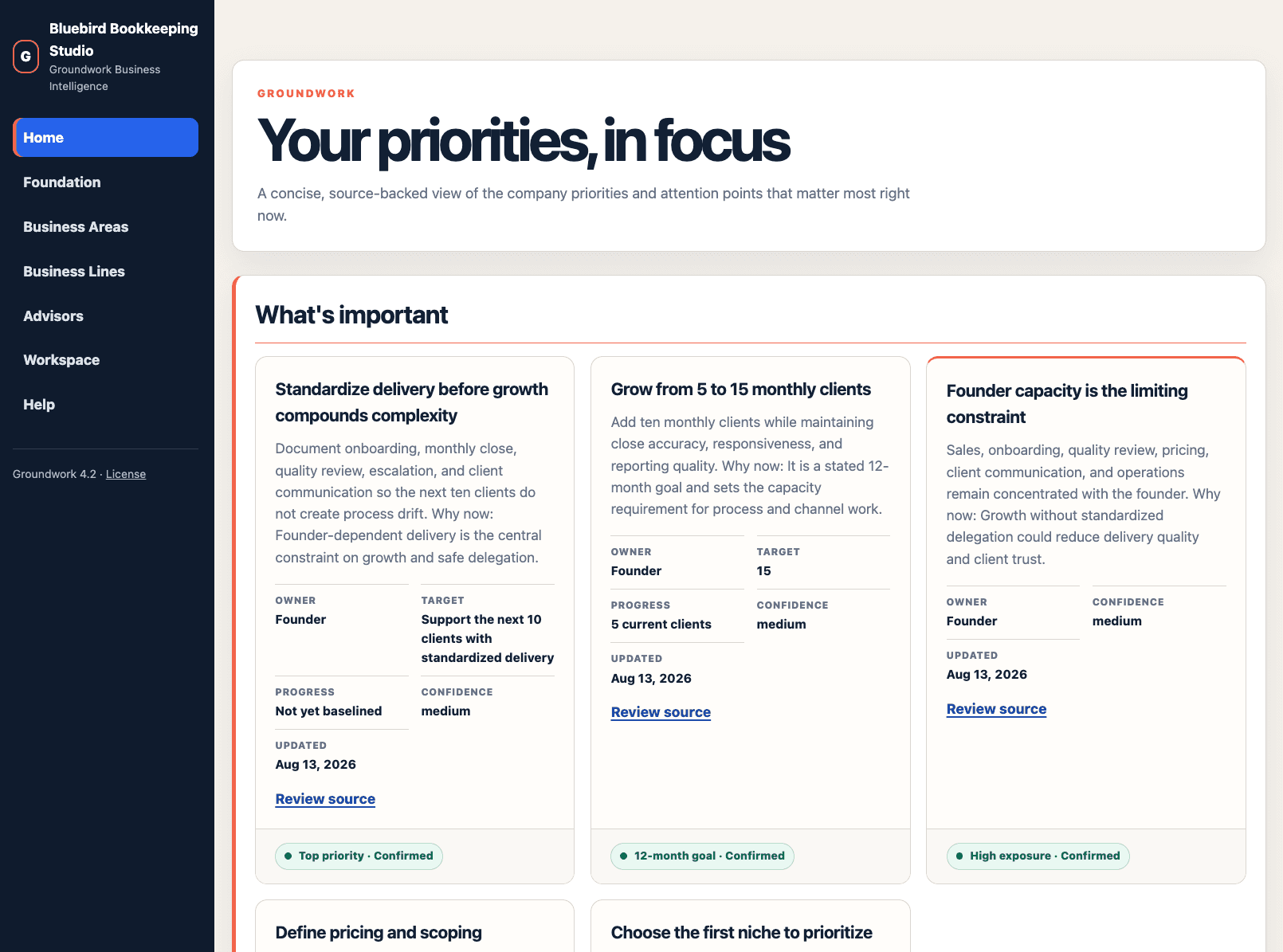
  • Your business identity, current situation, mission, and top goals
  • Current priorities, initiatives, risks, and important decisions
  • Source quality, missing information, and highest-priority questions
  • Recent changes, trends, advisor recommendations, and next actions
  • A central overview of your business profile, strategy, and business model
  • The current goal of every AI advisor
The private Groundwork website showing company priorities, owners, targets, progress, confidence, and source links.

The business foundation

Start with the information every part of the company should understand.

Your profile, strategy, and business model create a shared starting point for the rest of the system and every advisor.

Business Profile

Keep a clear record of who the company is and how it should be described.

  • What the business does, its industry, and location
  • Mission, vision, values, ownership, and company stage
  • Approved descriptions of the business
  • Important identity questions that still need answers

Strategy

Keep direction, priorities, and the decisions shaping the company visible.

  • Company goals and strategic priorities
  • Positioning and current initiatives
  • Important tradeoffs and direction-setting decisions
  • Strategic questions that remain unresolved

Business Model

Explain how the company makes money and what affects its economic health.

  • Recurring and non-recurring revenue
  • Profitability, unit economics, and scalability
  • Dependencies and constraints
  • Business-model assumptions that still need validation

Shared business pages

Keep every major business area connected.

Groundwork gives each area enough detail to be useful while connecting it back to the same goals, decisions, evidence, and current priorities.

Customers and offers

Understand who buys, why they buy, what you sell, and where the experience or offer needs work.

  • Segments, ideal customers, buyers, needs, and pain points
  • Buying triggers, retention, churn, and experience gaps
  • Products, services, pricing, packaging, and known margins
  • Upsell opportunities, delivery difficulty, and offer weaknesses

Product and service direction

Connect customer learning with priorities for improving what the business delivers.

  • Vision, strategy, roadmap, and improvement requests
  • Customer feedback and user experience issues
  • Adoption, engagement, retention, and product-market fit signals
  • Experiments, launch plans, risks, and dependencies

Sales and marketing

Review how the business attracts interest, earns trust, and converts opportunities.

  • Channels, pipeline health, conversion, and win or loss reasons
  • Qualification, objections, proposals, and follow-up gaps
  • Positioning, messaging, campaigns, content, and website clarity
  • Proof points, reviews, testimonials, and marketing gaps

Finance and metrics

Keep the financial picture and the measurements behind decisions organized.

  • Revenue, margin, profit, cash flow, runway, and major costs
  • Pricing assumptions, financial risks, and missing information
  • Metric definitions, targets, actual results, frequency, and ownership
  • Data quality and connections to goals and recommendations

Initiatives and operations

Track the work moving the company forward and how reliably it is delivered.

  • Purpose, owner, status, priority, next milestone, and review date
  • Dependencies, risks, decisions, and advisor recommendations
  • Delivery workflows, capacity, bottlenecks, and quality issues
  • Vendors, manual work, fragile processes, and growth limits

Technology and risk

See whether the company’s tools fit its needs and keep important risks visible.

  • Software, automations, AI workflows, data, reporting, and tool fit
  • Technology constraints and opportunities
  • Financial, operational, legal, compliance, people, and continuity considerations
  • Likelihood, impact, ownership, mitigation, and review dates

Decisions and assumptions

Preserve why important choices were made and separate proven facts from beliefs that still need testing.

  • What was decided, when, by whom, and why
  • Alternatives, expected impact, and next review date
  • Assumptions, confidence, and the risk of being wrong
  • What would validate each assumption and when to revisit it

Business lines

A dedicated view for every distinct part of the business.

Groundwork separates products, services, subscriptions, programs, brands, locations, and other revenue lines when they need their own operating view.

Customers, customer problems, offers, packages, pricing, and positioning
Product or service direction, roadmap, and improvement priorities
Sales, marketing, revenue, costs, and performance measures
Operations, delivery, technology, and current initiatives
Risks, decisions, assumptions, and unanswered questions
A clear separation between line-specific information and facts shared across the company

Eleven business advisors

Different perspectives. The same business reality.

Every advisor reviews the same current company information through a specific lens. Each one has clear goals, skills, questions, learned knowledge, and limits.

Strategy Advisor

Clarifies priorities, positioning, tradeoffs, growth choices, and long-term direction.

Product Advisor

Improves product or service direction, roadmaps, customer value, experiments, and adoption.

Voice of Customer Advisor

Turns feedback, reviews, interviews, complaints, and service experiences into a clear customer perspective.

Finance Advisor

Reviews pricing, margins, profitability, cash flow, costs, customer economics, and financial risk without inventing numbers.

Marketing Advisor

Improves audience clarity, positioning, messaging, content, channels, proof points, and brand trust.

Sales Advisor

Reviews lead quality, pipeline realism, qualification, follow-up, objections, conversion, and expansion.

Operations Advisor

Finds bottlenecks, capacity limits, handoff problems, rework, quality risks, and fragile processes.

Technology Advisor

Reviews software, data, reporting, automation, integrations, and how well the tools fit the company.

AI Advisor

Finds practical ways to use AI with attention to value, feasibility, risk, and human oversight.

People Advisor

Reviews roles, accountability, workload, hiring needs, capability gaps, and key-person dependency without storing unnecessary employee details.

Risk Advisor

Pressure-tests plans for financial, operational, legal, compliance, continuity, and reputation risks.

Every advisor has a page you can inspect.

  • Its role, responsibilities, and limits
  • Current goals for your business and the areas it reviews
  • Skills, decision methods, and curated knowledge you have taught it
  • Important questions, recent recommendations, and suggested prompts
  • Discussions you explicitly chose to save
  • Links back to the business information behind its recommendations

Business management tools

Find what needs attention and keep the system healthy.

Groundwork includes practical tools for questions, evidence, files, maintenance, design, updates, and the ongoing quality of your business information.

Generated Files

Find reports, documents, spreadsheets, presentations, images, exports, and other saved deliverables.

Question Library

Work through the questions that would most improve your business record and keep completed answers visible.

Glossary

Teach Groundwork your product names, aliases, nicknames, and company-specific language.

Groundwork Rules

See how information is organized, uncertainty is handled, and website updates are reviewed.

Website Design Controls

Preview and approve colors, typography, spacing, cards, buttons, tables, navigation, and responsive behavior.

Change Log

See what changed, when it changed, which areas were affected, and whether the website stayed in sync.

Source Health

Find stale information, weak evidence, conflicts, open questions, review dates, and maintenance needs.

Evidence Library

See which sources support each fact, when they were received, how trustworthy they appear, and what conflicts were found.

Review Queue

Focus on decisions, assumptions, weak areas, conflicts, questions, and recommendations that need attention next.

Upgrades and Patches

Review updates and see how they may affect business information, customizations, advisor knowledge, history, and files.

Review notes

Business information stays easier to review.

Groundwork helps show what changed, what is uncertain, and which information advisors are using.

One organized business record

The website displays your information from one organized business record.

  • Information can be updated in one place and reflected across related pages
  • Company-wide facts are kept easier to compare across pages
  • Meaningful updates can be recorded as the website changes
  • Older information can be marked as replaced or archived

Facts, assumptions, and unknowns stay separate

Groundwork helps keep gaps visible instead of treating guesses as confirmed facts.

  • Unknown information becomes a visible question
  • Conflicts remain visible until you resolve them
  • Important facts include their source, confidence, and review date
  • Answers explain what they are based on and what is still missing

Advisors share the same reality

Each advisor offers a different perspective while pointing back to the same business pages.

  • Advisor knowledge stays separate from company facts
  • Learning material is curated instead of copied in as a raw dump
  • Discussions are saved only when you ask
  • Recommendations link back to the relevant business pages

Changes stay reviewable

Important updates can include notes, warnings, and review steps so changes are easier to understand.

  • Higher-impact changes can be reviewed before you apply them
  • Business records, history, files, knowledge, and customizations can be checked during updates
  • Uncertain update conflicts wait for your decision
  • Monthly reviews bring all eleven advisors together

Pricing

Build your business context once.

Get the complete system in a folder on your computer, use it with your preferred AI tools, and adapt it as your company changes.